
Explore 5 key AI trends in 2025 — from agentic AI to predictive analytics — and how they’re transforming business and industry in India.
In 2025, one question is echoing through boardrooms, startup meetings, and factory floors alike:
“How do we stay competitive in an AI-powered world?”
The answer lies in understanding where AI is going — not just in theory, but in practice.

From agentic AI to predictive analytics and multi-modal intelligence, artificial intelligence is no longer a futuristic buzzword. It’s a working engine behind business growth, industrial efficiency, and customer delight — especially for Indian enterprises in sectors like manufacturing, logistics, e-commerce, BFSI, and IT.
And with the global AI market projected to hit $830 billion by 2030, companies that treat AI as a “future investment” are already falling behind.
In this blog, we explore five real, rapidly evolving AI trends in 2025 that are changing how industries think, operate, and compete — explained simply, with examples that resonate with Indian readers.
Let’s break it down.
🚀 1. Agentic AI: The Age of Autonomous Decision-Makers
agentic AI
autonomous agents, AI decision-making, workflow automation
Most businesses have automated tasks. But what if your AI could also think, plan, and act?
That’s the promise of agentic AI — systems that behave more like assistants than tools. Unlike traditional automation that follows a rigid script, agentic AI is adaptive, goal-driven, and capable of making decisions in real time.
💡 What’s Changing in 2025?
In 2025, agentic AI is no longer theory. Thanks to memory-augmented models and tighter integration with CRMs, ERPs, and email tools, businesses are deploying autonomous AI agents to handle:
- End-to-end workflows (e.g., automating HR onboarding)
- Intelligent email sorting, summarizing, and drafting
- Procurement and supply chain escalation handling
- Customer support ticket triaging and resolution
🛠️ Example from India:
A mid-sized logistics firm in Pune uses agentic AI bots to autonomously manage warehouse inventory, reorder supplies based on demand patterns, and send predictive maintenance alerts — reducing manual checks by over 40%.
🧠 What You Should Remember
Agentic AI isn’t about replacing humans. It’s about giving your team a digital co-worker who’s tireless, smart, and shockingly efficient. Expect it to become mainstream in the next 2 years — especially in India’s mid-tier business sector.
🔮 2. Predictive Analytics: Seeing Tomorrow, Today
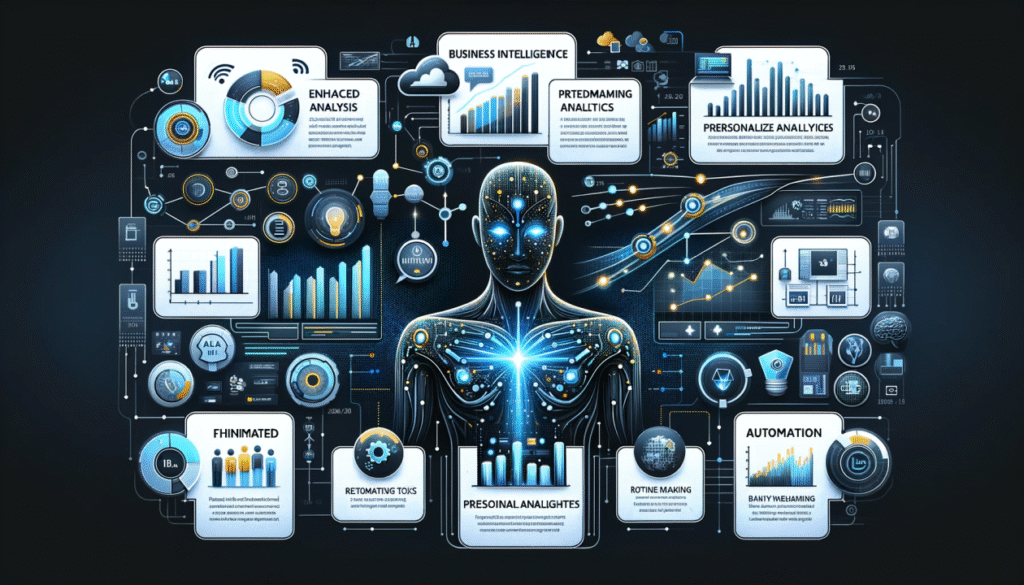
predictive analytics
data forecasting, AI insights, business intelligence, predictive modeling
If hindsight is 20/20, predictive analytics is like having 2020 vision into the future.
It uses historical data, patterns, and machine learning models to predict outcomes — whether it’s stock levels, customer churn, or supply chain bottlenecks.
📈 Why It Matters in 2025
While it’s been around for a while, 2025 has supercharged predictive analytics by making it:
- More accurate: Better models + bigger datasets = smarter predictions
- Easier to use: Tools like Microsoft Fabric, Power BI, and Zoho Analytics now offer drag-and-drop predictive modeling
- More accessible: Even SMEs can now leverage it without needing data scientists
🧪 Example:
A Bengaluru-based FMCG brand predicts sales dips in Tier 2 cities based on local festival calendars and rainfall patterns. With predictive analytics, they now pre-position inventory accordingly — reducing delivery delays by 18%.
🧠 What You Should Remember
In 2025, guessing is expensive. Predictive analytics gives businesses a data-backed crystal ball — turning “what if” into “what next.”
🎥 3. Multimodal AI: Understanding Like Humans Do
multimodal AI
AI image recognition, audio analysis, AI for video, cross-modal learning
Your brain can look at a traffic signal, hear a honk, and decide to stop — all within a second. That’s multi-modal intelligence.
Now AI can do the same.
Multimodal AI processes and understands data from different sources (text, images, audio, video) together, just like humans. It’s already improving areas like:
- Product quality inspection in factories (image + sensor data)
- Retail surveillance and theft detection (video + motion)
- Customer service chatbots (text + voice tone + context)
🧠 “ChatGPT Vision” and tools like Gemini and Claude are already showing how AI can understand and describe photos, analyze graphs, and write reports based on visual data.
🏭 Real-World Use:
An automotive parts plant in Tamil Nadu uses multimodal AI to visually inspect parts using cameras, analyze defects, and recommend process changes in real time. It reduced defects per 1,000 units by 32%.
🧠 What You Should Remember
Multimodal AI is not science fiction. It’s powering everything from retail recommendation engines to drone-based agriculture monitoring in India — making AI more human-like in how it sees and understands the world.
🧩 4. AI Reasoning with Enterprise Data: Smarter, Context-Aware Responses
reasoning AI
enterprise AI, document summarization, AI knowledge workers, AI reasoning engines
Generative AI is great at talking. But reasoning AI? It knows what it’s talking about.
It doesn’t just spit out answers — it thinks. It connects dots, checks for contradictions, and evaluates context. For enterprises, this means an AI that can:
- Read 100s of documents and draft summaries
- Extract insights from internal reports or policies
- Flag inconsistencies in large datasets
- Assist in compliance, audits, and legal reviews
🧠 Quote:
“Give it access to internal data, and it becomes a tireless knowledge worker,” says Shaun Hughes, founder of EfficiencyAI.
🧰 India Insight:
An IT firm in Hyderabad feeds all client onboarding documents into an AI system, which auto-generates project plans and flags potential scope mismatches — reducing pre-sales turnaround time by 60%.
🧠 What You Should Remember
Reasoning AI is like giving your business an in-house expert who never sleeps, forgets, or misplaces a file. It’s the future of internal decision-making — and 2025 is just the beginning.
🤖 5. AI-Powered Customer Service: Beyond Chatbots

AI customer service
AI support, voice bots, customer engagement AI, AI-driven CX
Let’s be honest — most chatbots until now have been frustrating.
But in 2025, AI-powered customer service is different. Today’s systems can:
- Remember previous interactions
- Detect sentiment and tone
- Handle complex queries across channels (voice, email, chat)
- Escalate only when necessary
🎧 Voice bots in regional Indian languages are helping rural banks and NBFCs provide 24/7 customer assistance — without human agents on standby.
📞 Example:
An EdTech startup in Noida uses multilingual AI voice assistants for onboarding new users. The AI guides users in Hindi, Tamil, or Bengali — leading to a 35% improvement in course completions.
🧠 What You Should Remember
AI in customer service is no longer about saving money — it’s about delivering delight at scale. Expect this space to explode in India, especially with growing demand for vernacular and regional language support.
📣 Final Thoughts: Adapt or Fall Behind
The AI revolution in 2025 isn’t happening in some far-off future. It’s here, reshaping how we sell, serve, manufacture, and grow.
Whether you’re a startup founder in Bengaluru, a supply chain head in Surat, or a marketing manager in Mumbai — the way you think about AI needs to evolve from “buzzword” to “business-critical.”
And the good news? You don’t have to become a tech wizard to start. Just begin by asking:“Where in my workflow do I make repeated decisions or face bottlenecks?”
That’s where AI can help.


Leave a Reply