
Genie 3 world model from DeepMind creates interactive 3D environments in real-time from text prompts — a major leap toward AGI and AI agent training.
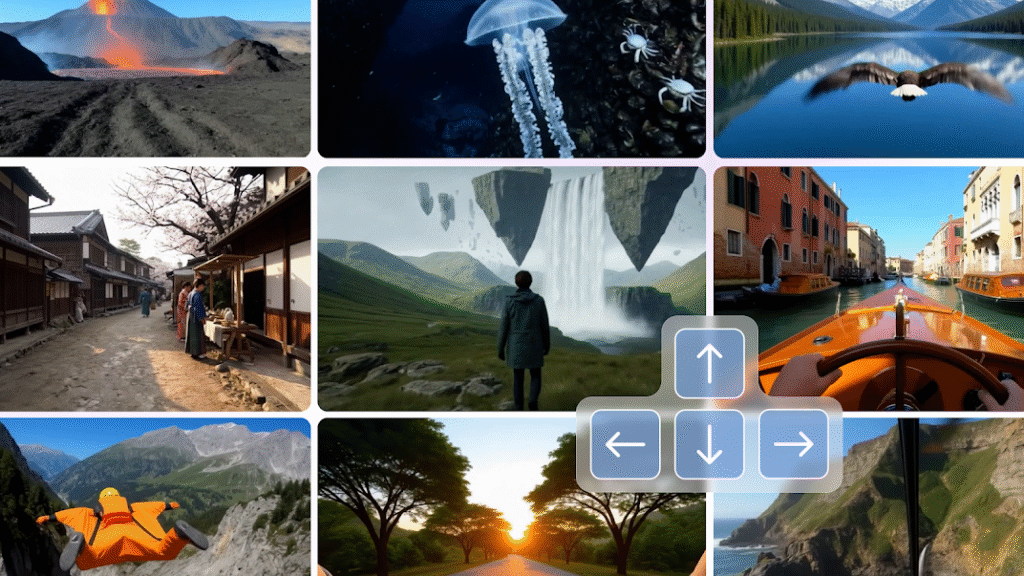
Ever wondered what it would feel like to walk into a world created by AI, change the weather mid‑journey, or add a bird with just a text prompt? That’s the magic behind the new Genie 3 world model from Google DeepMind. In just the first few seconds, you’ll get immersive in gorgeous 720p settings at 24fps. And the real kicker: it remembers what you saw—even if you look away and come back. Whether you’re a tech enthusiast, student, entrepreneur, or just curious about emerging AI, Genie 3 offers a peek into the future of interactive learning, gaming, and robotics.
🧠 What Is Genie 3—and Why It Matters (Genie 3 explained)
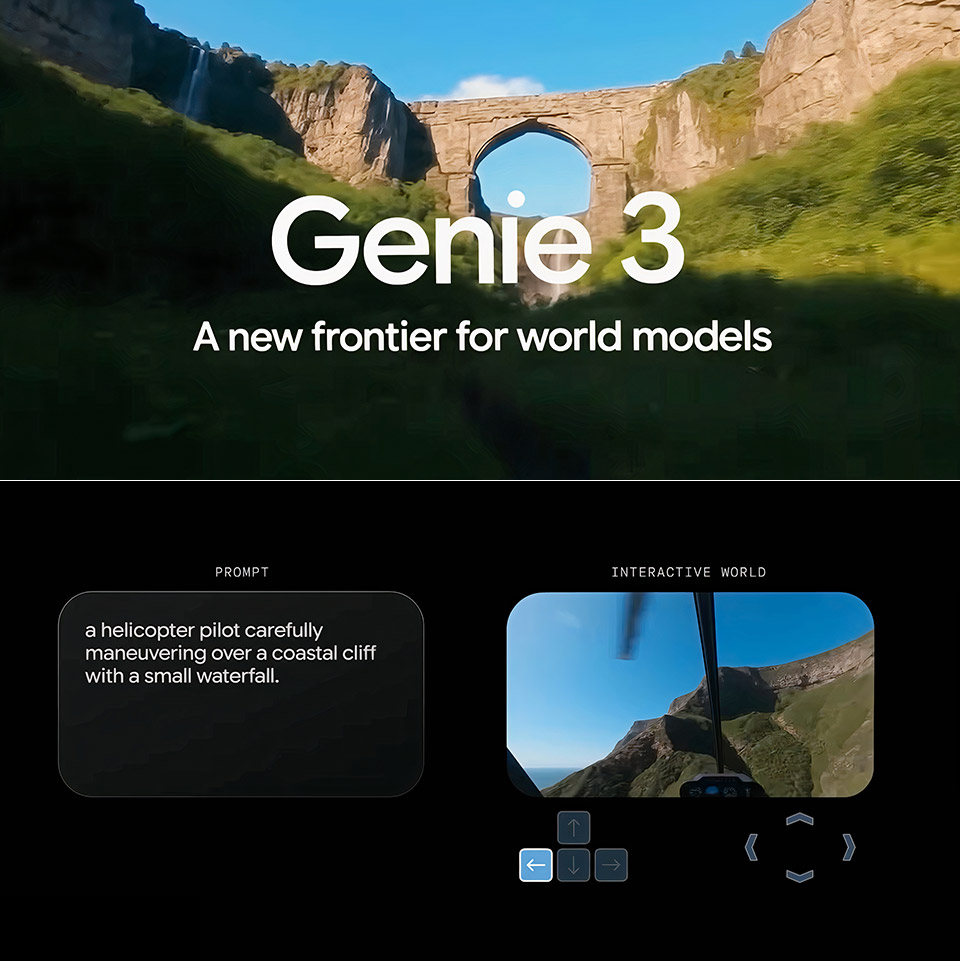
Genie 3 is the third iteration of DeepMind’s world models — AI systems capable of generating interactive, explorable 3D environments from simple text or image prompts arXiv+14Ars Technica+14Industry Leaders Magazine+14SiliconANGLE+5Businessworld+5The Guardian+5The Verge.
- Real-Time Interaction: Generate and navigate a world at 720p, 24fps, responding instantly to your commands Ars TechnicaThe Verge.
- Persistent Visual Memory: Objects remain consistent for around one minute, so revisiting a wall, a tree, or text yields the same view Ars Technica+2The Verge+2.
- Promptable World Events: Change weather, add animals, vehicles, or even trigger rain — all on the fly Ars Technica+3The News+3The Verge+3.
- Training AGI Agents: Designed to train embodied AI—robots, agents, self-driving systems—in safe, limitless environments Businessworld+1.
Result: A world model that’s more consistent, interactive, and visually rich than ever before.
What It Isn’t: It’s not yet public—Genie 3 is in a limited research preview, accessible only to select researchers and creators while DeepMind refines safety, ethical use, and technical constraints The NewsThe VergeThe Times of India.
Key takeaway:
Genie 3 isn’t just about creating pretty worlds—it’s about enabling AI agents to learn and train in dynamic, human‑like simulated spaces.
How Genie 3 Builds on Genie 1 & Genie 2
Genie 1 & 2 Recap
- Genie 1 (2024) introduced the idea: generate interactive 2D/game‑like worlds from videos and prompts, learning action control without labeled data THE DECODER+15syncedreview.com+15The News+15arXiv+2sites.google.com+2.
- Genie 2 (December 2024) was a leap. It generated playable 3D environments lasting up to a minute, with keyboard/mouse interaction and long-horizon memory (~10–20 s), from a single image prompt The Times of India+4deepmind.google+4O-mega+4.
What’s New with Genie 3
- Longer visual memory → up to one minute, compared to Genie 2’s few seconds Ars Technica+1.
- Higher fidelity → 720p and 24fps experience—even smoother interaction than before The News+3Ars Technica+3The Verge+3.
- Dynamic prompting in real-time, aka “promptable world events”—weather shifts, new objects, evolving scenes without restarting The News.
Key takeaway
Genie 3 sharpens the core Genie promise: seamless, evolving simulations that the model remembers and adapts to as you explore.
Real‑Life Use Cases (Examples, analogies & benefits)
🚗 Training Autonomous Vehicles
Imagine a car simulator where a pedestrian pops out, or a sudden obstacle appears. Agents trained in Genie 3 can experience edge cases in controlled virtual warehouses or roads — without real-world risk The GuardianBusinessworld.
👩💻 Education, Virtual Walkthroughs & Media
In India, schools or tech colleges could use Genie‑generated labs to visualize biological systems or engineering machines. The worlds adapt in real-time as students input different scenarios—like rainfall or equipment change.
🎮 Rapid Game Prototyping
Designers can spin up a full level in minutes: desert terrain, volcano eruption, NPCs milling around—all controlled with prompts. Then test gameplay without building every asset manually.
🤖 Robotics & Embodied Agents
AI robots like “Sima” (DeepMind’s virtual humanoid) can explore generated environments—learning spatial interactions and planning without needing physical hardware The Guardian.
Real‑world insight
These aren’t just futuristic demos; they mirror how humans learn—by exploring, tweaking and testing hypotheses in a safe sandbox.
Genie 3’s Major Challenges & Limitations
No world is perfect—even one created by AI.
- Memory Span Limit: Visual memory lasts only around one minute—not hours—which limits longer simulations Ars TechnicaThe News.
- Interaction Constraints: Users and agents can only take predefined actions (e.g. keyboard input); gestures or full physics aren’t yet supported.
- Text Generation Gaps: Written text in scenes may only appear if included in prompt; generative text on signs often fails The NewsThe Verge.
- Ethics & Safety: DeepMind is cautious—testing usage limits, bias control, and ensuring worlds aren’t misused The Times of India.
- Not Public Yet: Only a few researchers can use it now. No public API or release date announced The NewsThe Verge.
Quick summary
Genie 3 is powerful—but still early stage. Expect future models to expand memory, controls, graphics and accessibility.
Technical Foundations (Simplified)
DeepMind built Genie models using a blend of advanced AI building blocks:
- Spatiotemporal video tokenizer: Converts frames into discrete tokens capturing both imagery and motion dynamics.
- Latent action model: Learns the link between what happened in one frame and the next without labeled actions TechCrunch+4The Verge+4The News+4blog.lukmaanias.com+4syncedreview.com+4arXiv+4.
- Autoregressive dynamics model: Predicts the next tokens (future frames) based on prior states and user actions.
Think of it like cooking:
- Genie’s tokenizer is the chopped veggies,
- the action model is the recipe steps,
- and the dynamics model is the simmering pot that turns it into a meal—frame by frame.
All trained unsupervised on 11-billion‑parameter architecture, from unlabeled internet videos spanning games and robotics footage syncedreview.comsites.google.com+4arXiv+4blog.lukmaanias.com+4.
Final thought
Genie achieves its magic without labeled datasets—learning from raw video data like a child watching endless gameplay.
Why Genie 3 Helps Build AGI (Artificial General Intelligence)
For many researchers, world models are the next frontier in achieving AGI—a system that can understand and act across diverse tasks.
- DeepMind CEO Demis Hassabis views these models as central to his vision—a way for AI to learn not just from text or static data but via simulated experience The Guardian+2Ars Technica+2THE DECODER.
- A new DeepMind team led by Tim Brooks is focused on scaling real-time simulation tools, integrating Genie with other multimodal models like Gemini and Veo 3 THE DECODER+9The Verge+9techzine.eu+9.
- With unlimited curriculum of different worlds, AI agents can learn planning, reasoning, physical intuition, and adaptability—key AGI components.
Key takeaway
Genie 3 is more than tech—it’s a cornerstone in how AI may learn to think and act like humans, but safely within virtual worlds.
Tips & Insights for Indian Readers & Startups
- Universities & hackathons in India could lobby for access to Genie preview—use it to teach robotics or game design.
- Innovators can script prototypes using Indian landscapes: Himalayan trails, Marwari palaces, Mumbai streets—test cross‑cultural agent behavior.
- Collaboration potential: pair Indian language prompts (Hindi, Telugu) with Genie to craft multilingual simulation rooms.
- Mistakes to avoid:
- Relying solely on Genie-generated worlds without validation.
- Forgetting domain-specific rules—e.g. traffic behavior, cultural realism.
- Relying solely on Genie-generated worlds without validation.
- Real‑user insight: Early testers mention lag when adding complex objects, or seeing inconsistent textures near horizon edges.
One-liner
Though early-stage, Genie 3 offers India’s tech community a playground to experiment with world simulations rooted in local context.
✅ Summary Key Takeaways
- Genie 3 transforms text prompts into interactive, explorable 3D worlds with visual memory and real-time changes.
- Builds on Genie 1 & 2, stacking longer memory (≈1 min), higher resolution (720p), and live event triggering.
- Useful for AI agent training, robotics, game prototyping, and educational simulations.
- Largely experimental—limited access, with memory and interaction constraints.
- Tech stack includes video tokenizer, latent action model, dynamics model, all trained unsupervised on raw video.
Seen as a key stage toward AGI, teaching AI how to act and predict in virtual yet believable worlds.


Leave a Reply to Bhavesh Desai Cancel reply