
India Electric Mobility Index benchmarks states on EV adoption, infrastructure & innovation — Delhi, Maharashtra & Chandigarh lead. Discover your state’s score & roadmap.
Have you ever waited for hours at a petrol pump, only to wonder if there’s a cleaner, smarter way to travel? Electric vehicles (EVs) promise to free us from rising fuel costs and polluted air—but how do we know if they’re really catching on across India?
Enter the India Electric Mobility Index (IEMI). Launched by NITI Aayog on August 4, 2025, the IEMI offers a state‑wise performance score, revealing not just who’s leading the EV revolution—but why. This guide unpacks how Delhi, Maharashtra, and Chandigarh topped the leaderboard, and why your state’s next move could shape India’s journey to net zero by 2070.
India Electric Mobility Index
What is the India Electric Mobility Index? (Secondary Keywords: IEMI India, electric mobility dashboard)
NITI Aayog’s IEMI ranks all States and Union Territories out of 100 across 16 indicators, grouped under three themes:
1. Transport Electrification Progress
Tracks EV adoption rates—how many two-, three-, and four‑wheelers are on the road, and their year‑on‑year growth.
2. Charging Infrastructure Readiness
Assesses public and private charger availability, fast‑charging networks, and urban‑rural coverage.
3. EV Research & Innovation Status
Looks at R&D investment, local manufacturing capacity, and startup ecosystem strength.
This isn’t just data—it’s a comparative toolkit for motivated states to see who’s sprinting ahead and who needs to catch up The Economic Times+1The Times of India.
Takeaway: IEMI turns high‑level ambition into measurable, score‑based progress, motivating states to compete and collaborate.
Who’s Leading—and Why?
Delhi, Maharashtra & Chandigarh: The Early Trailblazers
In the 2024 edition, Delhi, Maharashtra, and Chandigarh emerged as IEMI frontrunners The Economic TimesThe Times of India. They topped all three pillars through:
- Bold state policies and incentives for EV buyers
- Dense EV charging networks in urban centers
- Strong public‑sector adoption (buses, government fleets)
They also benefited from early EV adoption trends: Delhi’s electric buses and shared EVs; Maharashtra’s manufacturing incentives; Chandigarh’s compact urban geography that made charging easier.
Noteworthy Runners‑Up
States like Karnataka, Tamil Nadu, Haryana, Telangana, Himachal Pradesh, and Ladakh scored high in specific categories—such as charging ecosystem or innovation maturity—but fell short of ranking overall leaders The Times of IndiaWikipedia.
Unexpected Story: Uttar Pradesh
According to May 2025 data, Uttar Pradesh leads India in sheer EV numbers—4.14 lakh registered EVs, more than double Delhi or Maharashtra (~1.8 lakh each) The Economic Times+4Wikipedia+4The Times of India+4.
But why didn’t UP top the IEMI?
- The bulk of its EV use is dominated by e‑rickshaws, a single segment
- Charger density remains low compared to EV‑heavy states
- Innovation and manufacturing scores lag behind coastal states
Still, UP’s rise signals that grassroots change can shift balance quickly.
Takeaway: High EV counts don’t automatically mean high IEMI scores—balanced growth across adoption, infrastructure, and innovation matters.
Why the IEMI Matters
For Policymakers
State officials can see exactly where they fall short—be it infrastructure deserts or missing R&D support—and tailor policies accordingly to bridge gaps.
For Private Sector & Startups
Upcoming players can spot high‑scoring states and follow the policy frameworks that laid the groundwork—whether for charger installation, battery innovation, or EV financing hubs.
For Citizen Engagement
Citizens can hold their local governments accountable: If your state ranks low, you can ask: Where are the chargers? Why aren’t adoption trends rising? State‑level benchmarking helps bring that conversation into public view.
Human metaphor: Think of the IEMI as a “GPS” for EV transformation, pointing each state toward exit ramps, charging stations, and safe zones.
Deep Dive: What Each Pillar Reveals
1. Transport Electrification Progress
- Tracks share of EV sales vs total registrations—India rose from 0.5% in 2018 to ~7.7% in 2024 The Times of India+2The Economic Times+2pib.gov.in+2The Times of India+2.
- As of June 2025, India hosts over 6.5 million EVs The Times of IndiaThe Times of India.
- States with balanced mix—two‑, three‑ and four‑wheelers—score better.
Mistakes to avoid:
- Focusing only on one vehicle category (e.g. e‑rickshaws)
- Ignoring fleet and public transport electrification
Tips for improvement:
- Incentivize all segments, including cargo and bus fleets
- Offer home‑charging subsidies, road‑tax waivers, and shared‑EV benefits
Takeaway: Broader adoption across vehicle types brings richer scores and lasting impact.
2. Charging Infrastructure Readiness
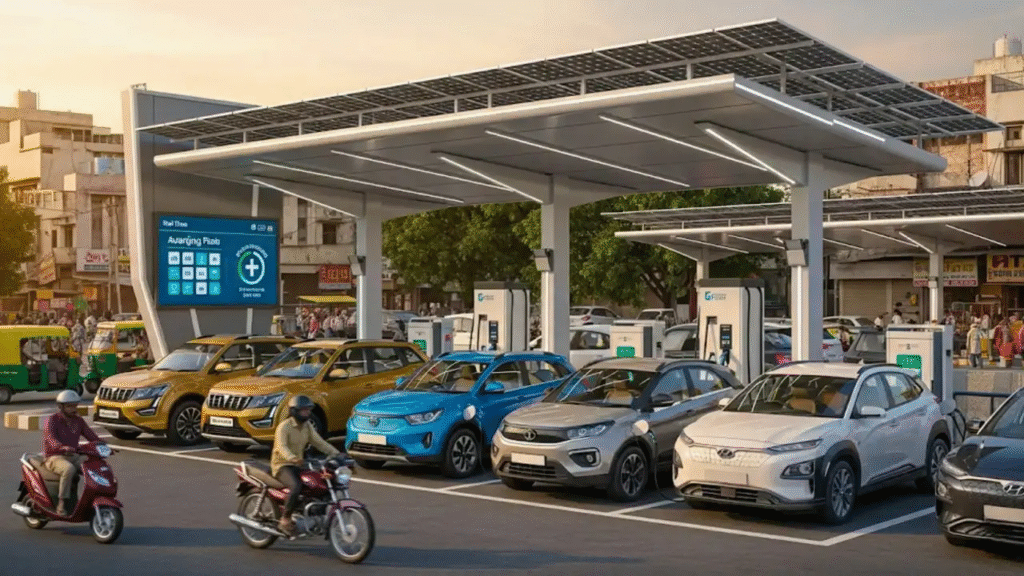
- India had around 25,000 public EV chargers by October 2024; Karnataka led installations The Times of IndiaWikipedia.
- In UP, 300 new charging stations are planned across 16 cities—including Ayodhya The Times of India.
- Yet, India’s EV‑to‑public‑charger ratio is still around 135, whereas the global ideal is 6–20 The Times of India.
Missteps:
- Installing slow chargers only
- Ignoring rural and peri‑urban gaps
What works:
- Targeted fast chargers in high‑traffic zones
- Utility engagement to support grid upgrades
- Home/workplace charger incentive schemes
Takeaway: Without chargers, EV adoption stalls—rich infrastructure is as crucial as policy.
3. EV Research & Innovation Status
- Evaluates academic and industrial R&D, manufacturing presence, patents, and startups.
- Coastal states with auto hubs or EV policies often score higher (Delhi, Maharashtra, Karnataka, Tamil Nadu).
Common pitfalls:
- Skipping local R&D investment
- Ignoring ecosystem development—charging component suppliers, factories, etc.
Actionable steps:
- Set up EV innovation labs, support startups via incubators
- Offer R&D grants, partner with universities
- Encourage battery and charger manufacturing clusters
Takeaway: Tech and innovation create local value beyond adoption—they power scalable growth.
Global Context & India’s Ambition
India’s EV vision is part of its net-zero roadmap by 2070. The EV market is growing at an estimated 49% CAGR through 2030, aiming for up to 30% EV penetration across segments by then The Times of Indianiti.gov.inThe Times of Indiapib.gov.in+1.
Under FAME II incentives, India hopes to push EV penetration to 30% in private cars, 40% in buses, 70% in commercial cars, and 80% in two/three‑wheelers by 2030, potentially saving over 800 million tonnes of CO₂ over vehicle lifetimes pib.gov.in+1.
The IEMI becomes a tracking beacon on that journey—ensuring India remains on course for sustainable transport transformation.
Human metaphor: If EV adoption is the rocket ship, the IEMI is its onboard navigation system—guiding states through policy milestones, charging gaps, and innovation check‑points.
What You Should Remember
- Balanced growth = high IEMI scores: Delhi and Maharashtra aced all three pillars. UP rose fast in adoption numbers—but lags in infrastructure and innovation.
- Charging is critical: Without fast and widespread chargers, EV use remains concentrated.
- Innovation spurs scale: R&D hubs and local manufacturing multiply impact beyond consumer adoption.
- Healthy competition matters: IEMI fosters competitive federalism—states learn from top performers and accelerate together.
CTA: What’s Your Take?
What trend are you seeing in your city or state? Have you noticed more EVs on the road—or more chargers going up? Share a success or frustration: what’s working, what’s missing—and how can your local leaders use tools like IEMI to drive real change?


Leave a Reply